Joseph HAYDN (1732-1809)
String Quartet in D Major, “Largo”, Op. 76, No. 5, Hob. III: 79 (1797)
I. Allegretto
II. Largo cantabile e mesto
III. Manuetto. Allegro
IV. Finale. Presto
When Haydn composed his final quartet set, Opus 76, in his sixties, he was perhaps the most celebrated living composer in Europe. Commissioned privately by Count Erdödy, the set quickly became one of his most popular and frequently performed collections. While Quartets No. 2 (“Quinten”), No. 3 (“Emperor”), and No. 4 (“Sunrise”) largely adhere to traditional forms and tonal structures, the fifth quartet, nicknamed “Largo”, stands out as a distinctive work within the set.
I. Allegretto
The opening movement immediately establishes the unique character of the piece. Rather than employing the conventional sonata-allegro form, Haydn structures the movement as a variation form, built on a lyrical and graceful opening theme. This theme, reminiscent of “With verdure clad”, an aria from his oratorio The Creation, unfolds through expressive alternation between major and minor.
A brief but dramatic episode interrupts the calm: dazzling violin scales and fierce cello accompaniment create a moment of turbulence and intensity. Yet the music soon returns gently to the opening theme. Following a moment of powerful silence, Haydn infuses the concluding section with increased animation and brilliance, culminating in a delightfully splendid coda.
II. Largo cantabile e mesto
This quartet was nicknamed “Largo” for its deeply expressive second movement, also the heart of the piece. Marked “Cantabile e mesto” (“songful and sad”), a pairing that may seem contradictory at first, this character is beautifully embodied in the hymn-like melody, tinged with melancholy yet infused with a quiet strength. Amidst this musical chiaroscuro, the viola and cello lead the gloomy central section. The movement concludes with a return of the pensive opening theme.
III. Menuetto. Allegro
The third movement, Menuetto, with its convivial dance theme, offers a relief from the emotional intensity of the Largo. The Trio section introduces a brief, shadowy interlude: the cello rumbles mysteriously, accompanied delicately by the higher strings. Here, the music is built around a repeated two-note cadence, counterpointed by cello scales that weave through the texture. The spirited main theme then returns, dispelling the darkness with renewed brightness and charm.
IV. Finale. Presto
The quartet concludes with an energetic rustic dance imbued with Gypsy spirit. The Finale opens with Haydn’s characteristic sense of humor, featuring his ending-as-beginning pun that immediately grabs the listener’s attention. Its brisk tempo and buoyant, leaping figures pose virtuosic challenges for the performers. In a delightful twist, Haydn alters the start of the recapitulation to spotlight the second violin, offering an unexpected and brilliant moment of virtuosity.
Man WU (1963- )
Glimpses of Muqam Chebiyat (2015)
I. Chebiyat Muqam – Muqaddima
II. Chebiyat Muqam – Third Dastan
Glimpses of Muqam Chebiyat is a two-movement suite which resembles a set of portraits of traditional cultures from around China. In Chinese traditional music, instrumental pieces often have poetic titles to express their content and style. I decided to continue this tradition with this collection. The inspiration for these suites came from styles of traditional music in China familiar to me, including Uyghur Maqam of Xinjiang province, a pipa scale from the 9th century, and the Silk-and-Bamboo music, or teahouse music, from my hometown of Hangzhou.
Glimpses of Muqam Chebiyat is adapted from the Uyghur Muqam Chebiyat. In 2010, thanks to the Aga Khan Music Initiative, I had the opportunity to learn these pieces directly from the Uyghur musicians Abdullah Majnun and Sanubar Tursun.
I feel quite grateful to be able to bring these old styles of traditional music—Uyghur Muqam, Jiangnan Silk-and-Bamboo music, and ancient pipa music—into the repertoire of Western string ensembles. The left-hand portamento, or sliding, technique called for here is quite distinct from the types of expression found in Western music. I hope that audiences will come to better understand the richness and diversity of music from China through these stories.
— Wu Man
Glimpses of Muqam Chebiyat was commissioned for Kronos Fifty for the Future, a project of the Kronos Performing Arts Association.
Dmitri SHOSTAKOVICH (1906-1975)
String Quartet No. 9, Op. 117 (1964)
I. Moderato con moto
II. Adagio
III. Allegretto
IV. Adagio
V. Allegro
Shostakovich’s Ninth Quartet a deeply personal quartet that is often viewed as part of a trilogy. Shostakovich dedicated his Seventh Quartet to the memory of his first wife, Nina Varzar. His Eighth was dedicated to “the victims of fascism and war”, and the Ninth Quartet was dedicated to his third wife, Irina Supinskaya. It took Shostakovich more than three years to complete this quartet – in which we begin to see elements of the composer’s later style appear, especially an embrace of silence and extremely slow tempos.
The power of Shostakovich’s musical language in this quartet lies in its ambivalence. His use of recurring themes and musical motives, presented and developed in various voices of the texture, and in various contrapuntal contexts, is in line with the rhetorical heritage of the string quartet going back to the time of Haydn and Mozart. The way in which these themes and motives are treated, however, is more in line with the soul-destroying rhetoric of Soviet double-speak.
The piece has five movements, all of which are linked together so that the music proceeds without pause. In the third movement, we hear hints of classic Shostakovich as he quotes Rossini’s William Tell Overture — a melody that would also appear in his 15th Symphony.
The final movement is as long as the previous four combined and is itself divided into five parts. At the beginning of this movement, themes from the first movement reappear. The dark theme from the fourth movement makes an appearance before we engage with a fugue, which sits at the heart of this movement. Each of the quartet’s major themes are restated, followed by a 200-bar crescendo into one of the most exhilarating endings Shostakovich ever composed.
Biography
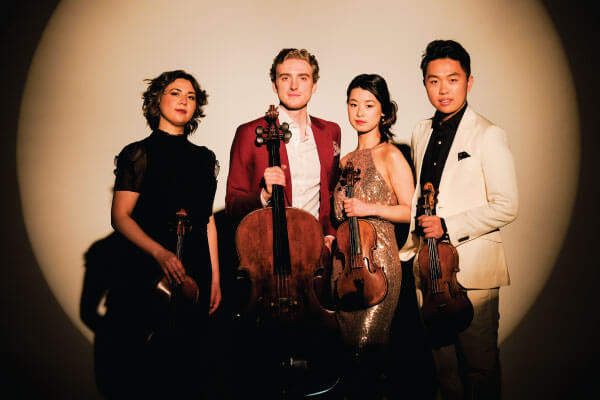
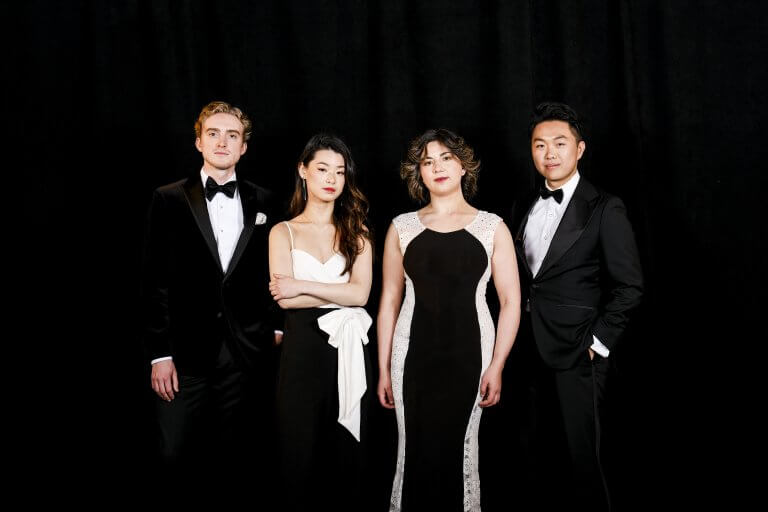
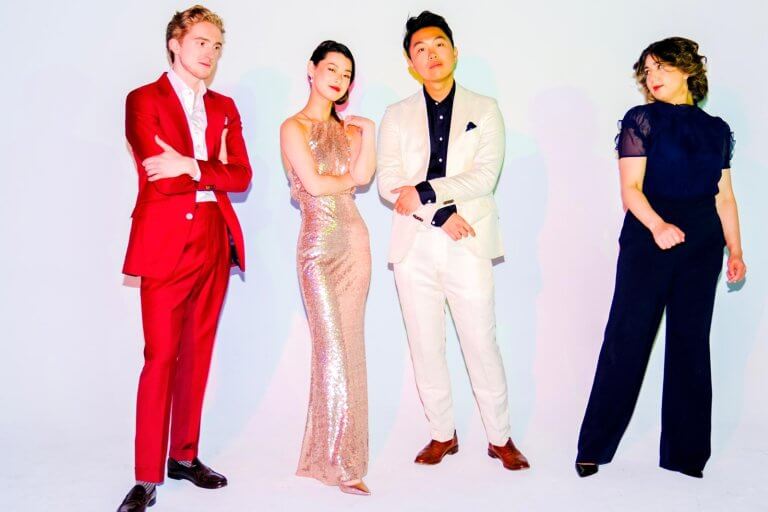
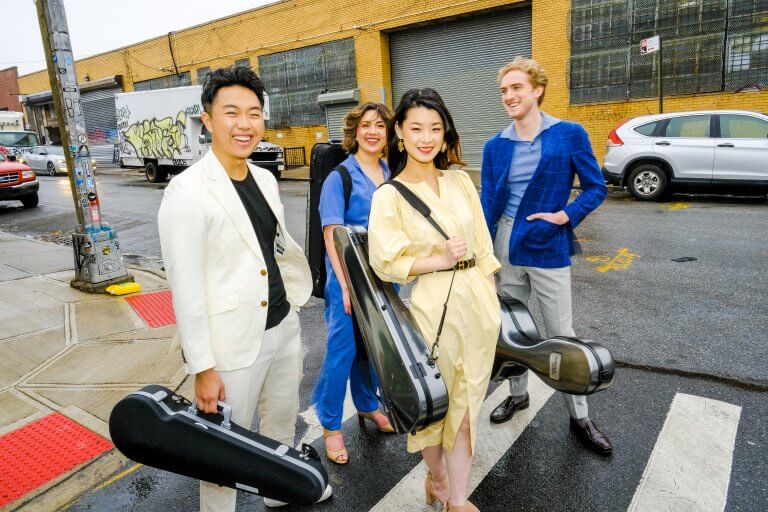
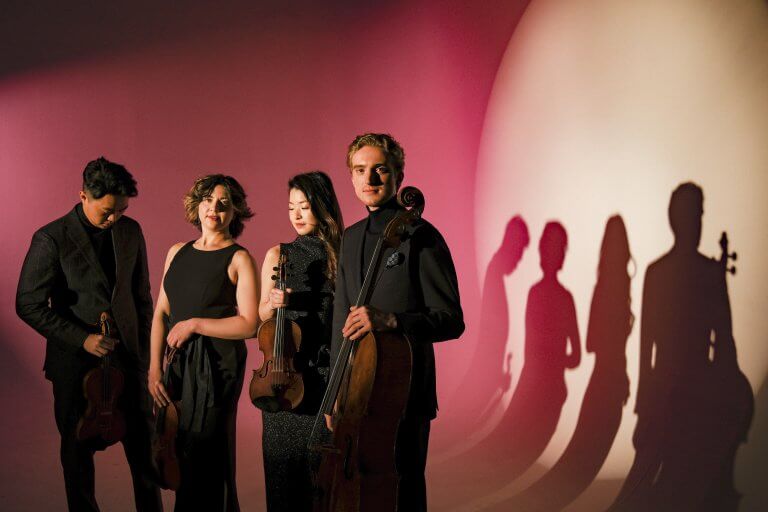
Viano Quartet
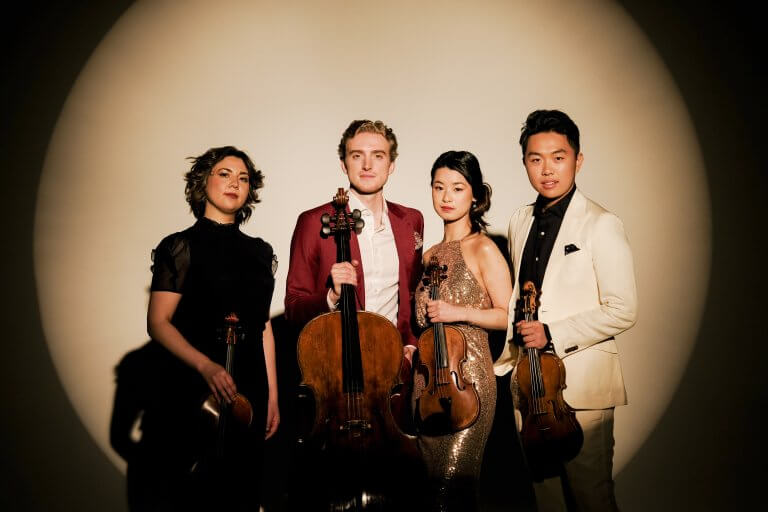
Praised for their “virtuosity, visceral expression, and rare unity of intention” (Boston Globe), the Viano Quartet has quickly soared to international acclaim as one of the most dynamic and in-demand string quartets of their generation. Winners of the prestigious Avery Fisher Career Grant in 2025, the ensemble has captivated audiences worldwide ever since they were awarded First Prize at the 13th Banff International String Quartet Competition, with appearances at renowned venues such as Lincoln Center in New York, Berlin’s Konzerthaus, Toronto’s Koerner Hall, Hong Kong’s City Hall, and London’s Wigmore Hall. The Viano Quartet are Bowers Program Artists at The Chamber Music Society of Lincoln Center from 2024–2027.
Highlights of the Viano Quartet’s 2025–26 season include debut performances at London’s Southbank Centre, the Frick Collection in New York, Dublin’s National Concert Hall, Coast Live Music, Friends of Chamber Music Kansas City, Apex Concerts, the Amelia Island Chamber Music Festival, the Fortas Series at the Kennedy Center, Premiere Performances HK, and a mainstage full recital debut at the Chamber Music Society of Lincoln Center.
The quartet also makes return appearances at Stanford Live, Forte Chamber Music, the Beaches Fine Arts Series, the Buffalo Chamber Music Society’s Slee Series (for the second half of their Beethoven cycle), Chamber Music Albuquerque, and the Sanibel Music Festival. The quartet looks forward to visiting residencies this season at Stanford University through the St. Lawrence Legacy Series, the University of Victoria, Music in the Morning in Vancouver, and the Auditorium Chamber Music Series at the University of Idaho. This season also features exciting collaborations with mandolinist Avi Avital, pianist Sir Stephen Hough, pianist Gilbert Kalish, clarinetist Anthony McGill, guitarist Miloš Karadaglić, and singer-songwriter Vienna Teng.
Equally committed to both beloved masterworks and contemporary repertoire, the Viano Quartet actively collaborates with today’s leading composers, including Sir Stephen Hough, Kevin Lau, Chris Rogerson, and Caroline Shaw. They are set to premiere a newly written string quartet by Indian-American composer Reena Esmail in the summer of 2026.
The quartet’s recent discography highlights the ensemble’s range across both traditional and modern repertoire. Their first full-length album Voyager was newly released in summer 2025 with Apple Music/Platoon Records. Inspired by humankind’s enduring spirit of exploration that connects music and people across vast boundaries, the album features Beethoven’s Op. 130 alongside Alistair Coleman’s Moonshot. Their debut EP Portraits was released in 2023 as one of the first albums to be launched on the Curtis Studio label, featuring works by Schubert, Florence Price, Tchaikovsky, and Ginastera.
Passionate about sharing their love for chamber music with the next generation of musicians, the quartet has worked with some of the most talented young artists at the world’s leading universities and music institutions, including Northwestern University, Music@Menlo Chamber Music Institute, the Colburn Academy, and Duke University. They have also collaborated with many of the world’s finest artists, including Emanuel Ax, Inon Barnatan, Fleur Barron, Mahan Esfahani, Marc-André Hamelin, James Ehnes, Bridget Kibbey, Paul Neubauer, David Shifrin, and Pinchas Zukerman.
The Viano Quartet was formed in Los Angeles at the Colburn Conservatory of Music in 2015. Each member of the quartet is grateful for the unwavering support from their mentors at the Curtis Institute and Colburn Conservatory, including members of the Dover, Guarneri, and Tokyo string quartets. “Viano” is a portmanteau that symbolizes how the four individual instruments of a string quartet—each beginning with the letter “v”—work harmoniously as one, like a piano, creating a unified instrument called the “Viano.”
Violin: Lucy Wang
Violin: Hao Zhou
Viola: Aiden Kane
Cello: Tate Zawadiuk
https://vianoquartet.com/
The content of this programme does not reflect the views of the Government of the Hong Kong Special Administrative Region.